

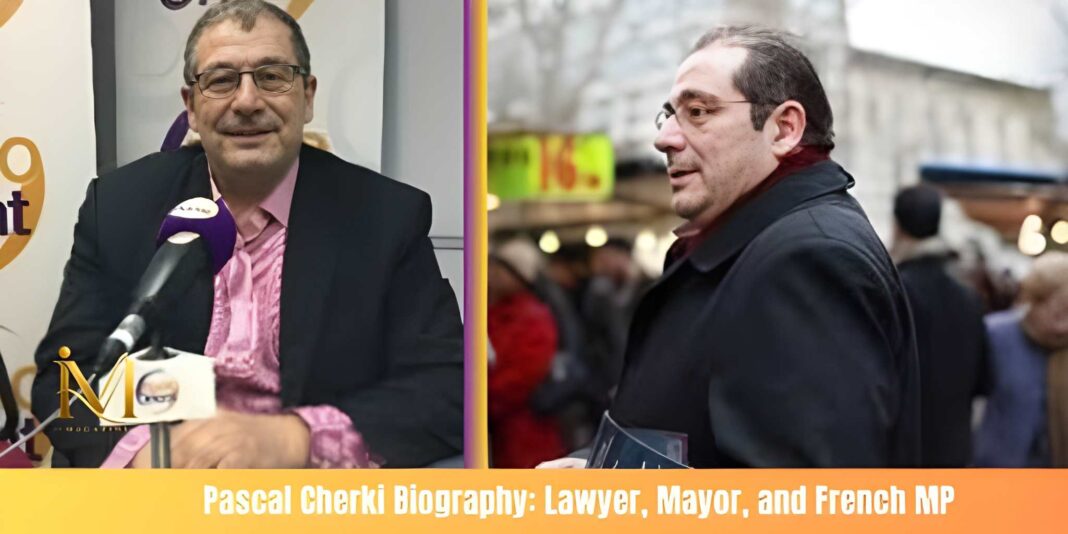

Pascal Cherki is a French lawyer and former politician who served as Mayor of the 14th arrondissement of Paris from 2009 to 2014 and as a Member of the National Assembly for Paris’s 11th constituency from 2012 to 2017. He is also known as a long-time figure of the French left, first inside the Socialist Party and later around Benoît Hamon’s Génération.s movement. Before his national role, he worked in Paris city politics as Deputy Mayor in charge of sports, then school life and educational success. After leaving elected office, he returned more clearly to his original legal career as a lawyer at the Paris Bar.
Quick Bio
| Field | Details |
|---|---|
| Full Name | Pascal Cherki |
| Date of Birth | September 1, 1966 |
| Birthplace | Paris, France |
| Nationality | French |
| Profession | Lawyer, former politician |
| Political Party | Former Socialist Party member |
| Later Movement | Génération.s |
| Famous For | Former Mayor of the 14th arrondissement of Paris |
| Mayor Role | Mayor from 2009 to 2014 |
| National Role | Member of the National Assembly from 2012 to 2017 |
| Constituency | Paris’s 11th constituency |
| Earlier Roles | Deputy Mayor of Paris for sports and school life |
| Political Position | Left-wing French politics |
| Current Work | Practicing lawyer at the Paris Bar |
Early Life and Legal Background
Pascal Cherki was born on September 1, 1966, in Paris, France. This detail appears in the official French National Assembly record, which lists his former parliamentary mandate and confirms his Paris birthplace. His public career was deeply linked to the city where he was born, studied, worked, and later held local office.
His professional base is law. Public legal directories list him as a lawyer registered with the Paris Bar, with his oath recorded in 1995. This matters because his political identity was not built only around party work. He also had a trained legal background before and after his years in elected office.
That legal side gives his career a different shape. Some politicians move from activism into public office and stay there for decades. Cherki followed a path that joined law, student politics, local government, national debate, and then a return to legal practice. This mix helps explain why his public image was often that of a political fighter, but also someone familiar with rules, institutions, and public administration.
How Pascal Cherki Entered Public Life
The public career of Cherki began through the world of the French left. He was connected to student activism and progressive politics before becoming a recognized elected official in Paris. French political life often builds local leaders through city councils, local party networks, and neighborhood work. Cherki followed that route.
His long relationship with the Socialist Party shaped much of his early political identity. The Socialist Party was one of the main forces of the French left for many years, and it produced major national leaders, mayors, ministers, and presidents. Within that party, Cherki became known as someone who stood on the left side of the Socialist family.
His political profile was not based on quiet loyalty alone. Pascal Cherki became known for speaking clearly when he disagreed with the direction of his own camp. This later became important during the presidency of François Hollande, when several Socialist lawmakers questioned the government’s economic and social choices.
Work as Deputy Mayor of Paris
Before becoming mayor of an arrondissement, Pascal Cherki served as Deputy Mayor of Paris from 2001 to 2009. During this period, he worked under Mayor Bertrand Delanoë. His responsibilities changed over time. He was first linked with sports from 2001 to 2008, then with school life and educational success from 2008 to 2009.
These roles were not small symbolic posts. In a large city like Paris, sports facilities, school support, and local education policy affect daily life for families, children, clubs, and neighborhoods. Sports policy can include public gyms, stadium projects, youth programs, and access to local activity spaces. School life can touch after-school support, equality in education, and services around public schools.
This part of his career shows the practical side of city government. National politics often gets more attention, but local offices deal with problems people see every day. For Pascal Cherki, the years as Deputy Mayor gave him experience in public services before he became a more visible national voice.
Mayor of the 14th Arrondissement of Paris
Pascal Cherki became Mayor of the 14th arrondissement of Paris in March 2009. He succeeded Pierre Castagnou, the Socialist mayor who had died in February that year. Le Parisien reported that Cherki was elected by the arrondissement council with 24 votes out of 30 voters.
The 14th arrondissement is an important part of southern Paris. It includes well-known neighborhoods such as Montparnasse, Pernety, Petit-Montrouge, and Montsouris. It is a residential, cultural, and active urban area, with local issues linked to housing, schools, transport, public spaces, and neighborhood services.
As mayor of the 14th arrondissement, Pascal Cherki had to manage local expectations while staying connected to the wider Paris city government. An arrondissement mayor in Paris does not have the same power as the mayor of the full city, but the role is still important. It brings the mayor close to residents, local associations, schools, and neighborhood debates.
His mayoral period lasted from 2009 to 2014. During those years, he remained part of the Paris left and continued to build a profile that was both local and political. His work in the 14th arrondissement helped make him a known name beyond internal Socialist Party circles.
Election to the French National Assembly
In 2012, Pascal Cherki was elected to the French National Assembly for Paris’s 11th constituency. The official National Assembly page records his mandate in the 14th legislature and notes that it ended on June 20, 2017. This seat gave him a national platform after years in Paris local government.
The National Assembly is the lower house of the French Parliament. Deputies debate laws, question the government, vote on budgets, work in committees, and represent their constituencies. For a politician like Cherki, this meant moving from local management into national lawmaking.
His constituency included parts of Paris connected to the 14th and 6th arrondissements. That made sense with his local base. Many French politicians build national careers by first becoming trusted in a specific city, district, or region. Pascal Cherki used his local Paris experience as the foundation for his parliamentary role.
His Political Position on the French Left
Pascal Cherki is often described as a politician of the left wing of the Socialist Party. This does not mean he was outside the Socialist world during most of his career. It means he often pushed for a more clearly left-leaning line inside it.
In France, the Socialist Party has long included different internal currents. Some members have supported more market-friendly reforms. Others have defended a stronger social state, more public spending, and a clearer break from centrist economic policy. Cherki was closer to the second side.
This position became more visible during François Hollande’s presidency. Some Socialist lawmakers felt the government had moved too far from its left-wing promises. They objected to parts of the government’s policy direction and became known as the “Frondeurs.” The word suggests rebels or dissenters inside the majority, not opponents from another party.
Pascal Cherki was linked with this current. Reports from the period described him as close to the Frondeurs and as one of the Socialist deputies who strongly challenged parts of Hollande’s direction. This gave him a stronger national image, even among people who did not follow Paris local politics closely.
The Frondeurs Period and Internal Party Debate
The Frondeurs period was one of the most important parts of Pascal Cherki’s national political identity. It showed his willingness to challenge his own government from within the left. For supporters, this made him principled. For critics, it made him difficult for party unity.
The debate was not only about personalities. It was about the future of the French left. Should the Socialist Party accept a more centrist path to govern? Should it defend a more traditional social democratic line? Should it move toward a more ecological and social model? These questions divided the party deeply in the 2010s.
Cherki’s role in that debate placed him among those who believed the left should not lose its social base. He was not the only one. Other lawmakers and activists shared this view. Yet Pascal Cherki was one of the more visible names because he spoke openly and because his disagreements were reported in national media. Reuters reported in 2013 that government figures reacted sharply to his criticism of François Hollande, showing how public those tensions became.
The Frondeurs did not become a single lasting party by themselves. Still, their criticism became part of a larger crisis inside the Socialist Party. After the 2017 presidential and legislative elections, the party was weakened, and many figures searched for a new political home.
Leaving the Socialist Party and Joining Génération.s
In October 2017, Pascal Cherki left the Socialist Party and joined the movement created by Benoît Hamon. Le Monde reported the move and described him as a former Frondeur deputy joining Hamon’s new project. That project was first called the 1 July Movement and later became Génération.s.
This was a major political choice. Cherki had spent decades in and around the Socialist Party. Leaving it showed that he believed the old party could no longer carry the political ideas he supported. For many people on the French left, 2017 was a turning point because the Socialist Party lost much of its old strength.
Génération.s tried to bring together left-wing, ecological, democratic, and social ideas. It was associated with Benoît Hamon’s 2017 presidential campaign, which had focused on themes such as social justice, ecological transition, and new forms of work. Pascal Cherki’s move therefore fit his long-standing place on the left side of socialist politics.
This change did not make him a new kind of public figure overnight. It was more like the next chapter of the same political line. Cherki had long argued for a more social and left-wing approach. Joining Hamon’s movement gave that position a new party home.
Return to Legal Work
After his parliamentary mandate ended in 2017 and his local elected role ended later, Pascal Cherki became more associated again with legal practice. Public legal profiles list him as an attorney at the Paris Bar and identify his cabinet in the 14th arrondissement of Paris.
This return to law is an important part of his story. It shows that his professional life did not depend only on elected office. Many former politicians move into consulting, media, business, or party work. Cherki’s public profile points back to the legal profession where he began.
The legal career also connects with his long experience in public affairs. A lawyer who has served in city government and Parliament brings knowledge of institutions, public decision-making, and political process. This does not mean his legal work is political, but it does give useful context to his professional background.
Public Image and Political Style
The public image of Pascal Cherki is built around three main ideas: local Paris leadership, left-wing political debate, and legal professionalism. He is not mainly known as a celebrity politician. He is better understood as a serious political actor who spent years inside public institutions.
His style has often seemed direct. He did not build his reputation by avoiding conflict. During the Hollande years, he became one of the names connected with internal Socialist opposition. That made him stand out at a time when the French left was debating its future.
At the same time, Pascal Cherki was not only a protest voice. He had already managed practical responsibilities in Paris. He had worked on sports, school life, arrondissement leadership, and parliamentary duties. That gives his career more balance than a simple “rebel politician” label would suggest.
Timeline of Pascal Cherki’s Career
Pascal Cherki was born in Paris in 1966. He entered the legal profession in the 1990s and became a lawyer at the Paris Bar. His elected career became more visible after 2001, when he served in Paris city government.
From 2001 to 2009, he worked as Deputy Mayor of Paris. His early city responsibilities focused on sports, then later on school life and educational success. In 2009, he became Mayor of the 14th arrondissement after Pierre Castagnou’s death.
From 2012 to 2017, Pascal Cherki served as a deputy in the French National Assembly for Paris’s 11th constituency. During this time, he became known for his role among Socialist lawmakers who challenged the Hollande government’s political direction.
In 2017, he left the Socialist Party and joined Benoît Hamon’s movement, later known as Génération.s. After the end of his elected roles, he returned more fully to law and remained publicly described as a former MP, former Paris councilor, and lawyer.
Why His Career Still Matters
The career of Pascal Cherki matters because it reflects a wider story about the French left. His path shows how a local Paris politician became a national voice during a period of deep political change. It also shows how the Socialist Party’s internal debates shaped the careers of many public figures.
His years in Paris local government show the importance of city-level politics. His time in Parliament shows the pressures faced by lawmakers when their party controls the government but does not satisfy all parts of its own base. His departure from the Socialist Party shows the political break that came after the 2017 crisis of the French left.
For readers trying to understand Pascal Cherki, the most useful point is this: he was not only a mayor, not only a deputy, and not only a lawyer. He was part of a generation of French left-wing figures who moved through activism, local government, national debate, party conflict, and professional life.
Conclusion
Pascal Cherki is best understood as a French lawyer and former left-wing politician whose career moved between Paris local government, the National Assembly, and legal practice. He served as Deputy Mayor of Paris, Mayor of the 14th arrondissement, and MP for Paris’s 11th constituency. He became especially known for his place on the left side of the Socialist Party and for his link to the Frondeurs during François Hollande’s presidency.
His story is also a story of political change in France. Pascal Cherki spent many years inside the Socialist Party, then left it in 2017 to join Benoît Hamon’s Génération.s movement. Today, public profiles mainly present him through his legal work and his past public service. For anyone studying modern French politics, his career offers a clear example of how local leadership, national disagreement, and professional life can meet in one public figure.
FAQs About Pascal Cherki
Who is Pascal Cherki?
Pascal Cherki is a French lawyer and former politician. He served as Mayor of Paris’s 14th arrondissement and later as a Member of the French National Assembly.
When was Pascal Cherki born?
Pascal Cherki was born on September 1, 1966, in Paris, France.
What political party was Pascal Cherki part of?
He was long associated with the Socialist Party. In 2017, he left the party and joined Benoît Hamon’s Génération.s movement.
Was Pascal Cherki a mayor?
Yes. Pascal Cherki served as Mayor of the 14th arrondissement of Paris from 2009 to 2014.
Is Pascal Cherki a lawyer?
Yes. Public legal directories list Pascal Cherki as a lawyer registered with the Paris Bar.